A Village That Chose Peace
Deir Yassin was a small Palestinian Arab village perched on a hill west of Jerusalem in Mandatory Palestine. By early 1948, its residents had made a deliberate choice: neutrality. The village elders signed a non-aggression pact with the Haganah, the main Zionist paramilitary organization, pledging to keep armed fighters out of their community.[1] It was a calculated act of self-preservation. It did not save them.
On April 9, 1948, approximately 120 fighters from two Zionist paramilitary groups, the Irgun (Etzel) and Lehi (the Stern Gang), launched an assault on Deir Yassin.[2] The Irgun was commanded by Menachem Begin. The Lehi was led by Yitzhak Shamir. Both men would later serve as Prime Ministers of the State of Israel.[3] The attack received logistical support from the Haganah and Palmach, including mortar cover.[4]
By the time the killing stopped, at least 107 Palestinian villagers were dead. Estimates range between 100 and 120.[5] The victims included women, children, and the elderly. Two days later, on April 11, Jacques de Reynier, head of the International Committee of the Red Cross delegation in Palestine, entered the village. His report, filed April 13, described the scene in clinical detail: bodies strewn through homes, evidence of close-range executions, and systematic destruction of property.[2]
The village elders signed a non-aggression pact with the Haganah, pledging neutrality. It did not save them. At least 107 villagers were killed on April 9, 1948.
Plan Dalet: The Blueprint
The massacre at Deir Yassin was not an aberration. It was consistent with a military blueprint that had been finalized exactly one month earlier.
Plan Dalet (Plan D) was approved on March 10, 1948, at the direction of David Ben-Gurion, who would become Israel's first Prime Minister.[1] The plan assigned each Haganah brigade commander a specific list of Palestinian villages to be captured, their populations expelled, and their structures demolished.[1] The tactics prescribed were precise: military siege, aerial and ground bombardment, forced expulsion of inhabitants, the burning of homes, and the use of TNT to reduce buildings to rubble so that residents could never return.[1]
Israeli historian Ilan Pappe, drawing on declassified Israeli military archives, described the operational logic plainly: "A Palestinian village was to be expelled if it was located on a strategic spot or if it put up some sort of resistance."[1] The threshold for destruction was low. Geographic inconvenience was sufficient cause.
On Deir Yassin specifically, Pappe wrote: "The systematic nature of Plan Dalet is manifested in Deir Yassin, a pastoral and cordial village that had reached a non-aggression pact with the Hagana in Jerusalem, but was doomed to be wiped out because it was within the areas designated in Plan Dalet to be cleansed."[1] The village's cooperation was irrelevant. Its coordinates sealed its fate.
The Propaganda of Terror
Begin understood the utility of Deir Yassin as a psychological weapon. In a message to his fighters after the massacre, he declared: "Tell the soldiers: you have made history in Israel with your attack and your conquest. Continue thus until victory. As in Deir Yassin, so everywhere, we will attack and smite the enemy."[3]
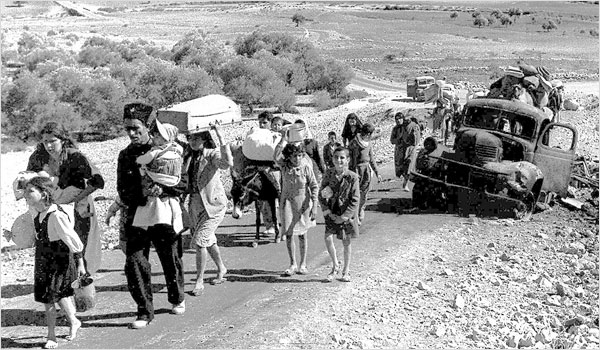
The statement was not a disavowal. It was a directive. And it worked. News of the massacre spread rapidly through Palestinian communities, amplified by both Arab and Zionist radio broadcasts.[4] The intended effect was panic, and the result was flight. Tens of thousands of Palestinians abandoned their homes in the weeks following Deir Yassin, fearing similar attacks on their own villages.[5]
"As in Deir Yassin, so everywhere, we will attack and smite the enemy." Menachem Begin, commander of the Irgun, later Prime Minister of Israel.
The Nakba by the Numbers
By 1949, at least 750,000 Palestinians had been made refugees.[3] Hundreds of villages were depopulated and subsequently demolished or repopulated with Jewish settlers.[1] The Arabic word for this event is "Nakba," meaning catastrophe. For decades, the Israeli state narrative framed the mass displacement as a voluntary departure, claiming that Arab leaders had instructed Palestinians to leave temporarily so that invading armies could operate freely. Declassified documents tell a different story.
In the late 1980s, a generation of Israeli scholars known as the "New Historians" gained access to declassified state archives. Benny Morris, Ilan Pappe, and Avi Shlaim published findings that contradicted the official account on nearly every point.[7] Morris's research, based on Israeli military and intelligence documents, identified dozens of cases where expulsion was carried out under direct military orders.[7] A declassified 25-page military document detailed the deliberate deployment of intimidation, forced marches, and destruction of property as standard operating procedures during the 1948 campaign.[1]
The evidence was not ambiguous. The archives revealed a coordinated, top-down policy of expulsion executed through a formal military plan, carried out by named commanders, and documented by the perpetrators themselves.
Declassified Israeli military archives revealed a coordinated, top-down policy of Palestinian expulsion, documented by the perpetrators themselves.
The Architects in Power
Perhaps the most revealing detail is what happened to the men who led the attack on Deir Yassin. Menachem Begin, commander of the Irgun, became Prime Minister of Israel in 1977. He signed the Camp David Accords the following year and received the Nobel Peace Prize.[3] Yitzhak Shamir, leader of the Lehi, served as Prime Minister from 1983 to 1984 and again from 1986 to 1992.[3] Neither man was prosecuted for the events of April 9, 1948. Neither expressed regret.
The men who planned and executed a massacre of civilians in a village that had agreed to peace were rewarded with the highest office in the state that massacre helped create. The trajectory from Deir Yassin to the Prime Minister's residence is not a contradiction within the Israeli national project. It is the clearest possible expression of it.
What the Record Shows
The historical record on Deir Yassin, Plan Dalet, and the Nakba is no longer a matter of competing narratives. The Israeli state's own declassified archives confirm the essential facts: a military plan to expel the Palestinian population was drafted, approved at the highest levels, distributed to field commanders, and executed systematically across hundreds of villages.[1][7] The massacre at Deir Yassin was one operation within that campaign. The 750,000 refugees it produced were not collateral damage. They were the objective.
The documents exist. The signatures are on file. The question is not what happened. The question is why, after decades of archival confirmation, the standard Western account of 1948 still treats Palestinian displacement as a mystery rather than a policy.
Sources
- [1] Ilan Pappe, "The Ethnic Cleansing of Palestine" (2006) — https://www.amazon.com/Ethnic-Cleansing-Palestine-Ilan-Pappe/dp/1851685553
- [2] Jacques de Reynier, ICRC Report on Deir Yassin — https://israelpalestinenews.org/deir-yassin/
- [3] Al Jazeera, "The Deir Yassin Massacre: 75 Years Later" — https://www.aljazeera.com/news/2023/4/9/the-deir-yassin-massacre-why-it-still-matters-75-years-later
- [4] Britannica, "Deir Yassin" — https://www.britannica.com/place/Deir-Yassin
- [5] IMEU, "The Deir Yassin Massacre" — https://imeu.org/article/explainer-the-deir-yassin-massacre
- [6] Jewish Virtual Library, "Plan Dalet" — https://jewishvirtuallibrary.org/plan-dalet-for-war-of-independence-march-1948
- [7] Benny Morris, "The Birth of the Palestinian Refugee Problem Revisited" (2004) — https://www.amazon.com/Birth-Palestinian-Refugee-Problem-Revisited/dp/0521009677