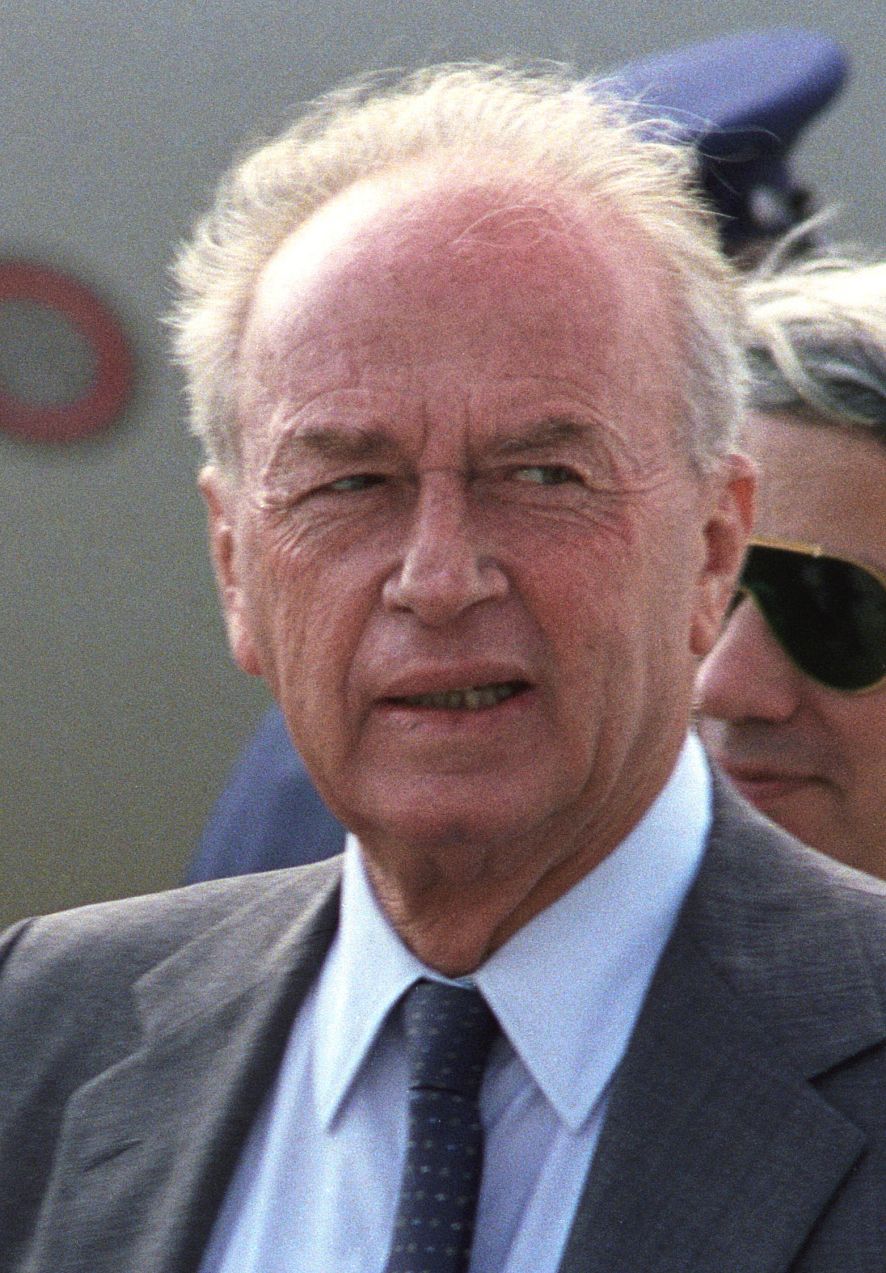
On the night of November 4, 1995, Israeli Prime Minister Yitzhak Rabin stood on a stage at the Kings of Israel Square in Tel Aviv, addressing a crowd of over 100,000 people at a peace rally.[1] Minutes later, as he walked toward his car, a 25-year-old law student named Yigal Amir fired three shots from a Beretta 84F semi-automatic pistol into Rabin's back.[2] Rabin died approximately forty minutes later at Ichilov Hospital.[1] He had refused to wear a bulletproof vest and had declined the use of an armored car.[4]
The assassination was treated as the act of a lone extremist, a Bar-Ilan University student radicalized by opposition to the Oslo Accords.[2] That framing held for a time. Then the details about Shin Bet's paid informant began to surface, and the official narrative buckled under its own contradictions.
The Agent Called "Champagne"
Avishai Raviv was recruited by Shin Bet in 1987, when he was just twenty years old.[5] His codename was "Champagne." His mission: infiltrate and monitor radical Jewish extremist groups operating in Israel and the occupied territories.[5] He was not a passive observer. In 1993, Raviv founded a group called Eyal on the campus of Bar-Ilan University, the same institution where Yigal Amir studied law.[5] He created multiple front organizations that claimed responsibility for acts of violence they had never committed, all under the direction and supervision of his Shin Bet handlers.[5]
Shin Bet had a paid agent who founded an extremist organization on the same campus where the assassin studied. The agency later claimed it had no intelligence on Amir.
This is the central, irreducible problem. Israel's domestic intelligence service had a salaried operative embedded in the very ideological ecosystem that produced Rabin's killer. Raviv moved through the same radical circles as Amir. He organized provocative actions designed to draw out extremists. And yet, according to the official record, Shin Bet failed to identify Amir as a threat.[4]
Raviv was eventually charged with failure to prevent a crime. On March 31, 2003, he was acquitted.[5] The court described him as "a weak person... who wanted to be liked" by his Shin Bet controllers.[5] The acquittal raised more questions than it answered: if Raviv bore no criminal responsibility, the implication was that Shin Bet itself bore a far greater share.
Two Warnings, Zero Action
The Shamgar Commission, headed by former Supreme Court Chief Justice Meir Shamgar, was tasked with investigating the assassination and the security failures surrounding it.[1] Its findings confirmed what many suspected: Shin Bet had ignored threats emanating from Jewish extremist circles and had committed serious security failures at the rally itself.[1]
Two specific prior warnings about threats to Rabin's life were received and not acted upon.[4] The commission found that the Israel Security Agency (Shin Bet) had been overwhelmingly focused on Palestinian threats, systematically underestimating the risk posed by Jewish radicals.[4] This was not a minor miscalculation. It was an institutional orientation that rendered an entire category of threat invisible.
Two prior warnings about threats to Rabin were received by Israeli intelligence. Neither was acted upon. The Shamgar Commission confirmed these failures but stopped short of assigning accountability.
Yet the commission's own scope proved to be its most telling feature. It failed to adequately address the intelligence dimensions of the case.[4] It did not thoroughly investigate Raviv's role or Shin Bet's operational control over him.[4] It identified the failure but avoided the hardest question: whether the failure was one of negligence, institutional blindness, or something worse.
The Political Aftershock
The assassination and Shin Bet's role in the events surrounding it have never stopped reverberating through Israeli politics. Benjamin Netanyahu has repeatedly claimed that Shin Bet-printed posters were used to incite against Rabin in the period before the killing.[3] In 2023, Finance Minister Bezalel Smotrich stated at a Rabin memorial event that Shin Bet had "encouraged" the assassination.[2] The accusation was extraordinary, leveled by a sitting cabinet minister against the state's own security apparatus.
Hundreds of former Shin Bet agents responded by accusing Netanyahu of "promoting conspiracy theories" about the agency's involvement.[3] Their collective pushback was fierce: the intelligence community closing ranks. Amir himself, from prison, offered his own rebuttal: "The Shin Bet never could have been alerted. The Shin Bet didn't know anything about me at all."[5]
That statement, taken at face value, contradicts the established facts. Shin Bet had an operative who founded an extremist group on Amir's campus. Shin Bet received two warnings about threats to Rabin's life. Shin Bet was responsible for the prime minister's personal security on the night he was shot at close range in a supposedly secured area. Amir's claim of invisibility strains credulity when placed against this record.
What the Commission Left on the Table
The Shamgar Commission did important work. It documented the operational failures at the rally itself, the gaps in the security perimeter, the inadequate response protocols.[1] It established that Shin Bet had been structurally unprepared for a threat from within the Jewish population.[4] These were significant findings.
But commissions of inquiry are defined as much by what they decline to investigate as by what they examine. Shamgar did not pursue the full scope of Shin Bet's relationship with Raviv. It did not interrogate the agency's decision to place a provocateur inside radical circles without, apparently, developing the intelligence product that such an operation should have generated.[4] It did not reconcile the existence of a paid asset inside the extremist milieu with the claim that no actionable intelligence about Amir was ever obtained.
Commissions of inquiry are defined as much by what they decline to investigate as by what they examine.
The documented facts are sufficient to establish a profound institutional failure. Shin Bet operated an agent inside the radical world that produced Rabin's assassin. It received and ignored warnings. Its protective detail allowed a gunman to approach the prime minister at point-blank range. These are not contested claims; they are the findings of Israel's own investigative commission.[1][4]
What remains unresolved is whether the failure was one of competence or something more deliberate. The Shamgar Commission chose not to answer that question. Three decades later, no subsequent investigation has answered it either. The file remains open in the most fundamental sense: the facts are known, but their meaning has never been officially determined.
Sources
- [1] Shamgar Commission Report — https://israeled.org/wp-content/uploads/2015/06/1996-3-28-Shamgar-Commission-Report-on-the-Assassination-of-Prime-Minister-Yitzhak-Rabin.pdf
- [2] Times of Israel: Smotrich Claims Shin Bet Encouraged Assassination — https://www.timesofisrael.com/at-rabin-memorial-event-smotrich-claims-shin-bet-encouraged-assassination/
- [3] Times of Israel: Ex-Shin Bet Heads Accuse Netanyahu — https://www.timesofisrael.com/ex-shin-bet-heads-accuse-netanyahu-of-lying-about-lead-up-to-rabin-assassination/
- [4] Washington Post: Israeli Assassination Report Berates Security Agency — https://www.washingtonpost.com/archive/politics/1996/03/29/israeli-assassination-report-berates-security-agency-top-officials/
- [5] Academic Paper on Intelligence Failure — https://www.academia.edu/32989177/
- [6] History.com: Yitzhak Rabin Assassinated — https://www.history.com/this-day-in-history/november-4/yitzhak-rabin-assassinated
- [7] Britannica: Assassination of Yitzhak Rabin — https://www.britannica.com/topic/assassination-of-Yitzhak-Rabin